Mark Origins
Where the dolmen comes from, and why it belongs to Verdegris
Verdegris is the parent of Trevarn. Its mark could not be an invented symbol; it had to come from the same ground. So it begins where Trevarn does — with the standing stones of the Atlantic west — and takes the one form a parent should: the dolmen, a great capstone resting across the uprights. The stones that hold Trevarn up, holding one more.
01The Name — Verdegris
Verdigris (EN), vert-de-gris (FR), is the blue-green patina that time leaves on weathered surfaces: the colour of age on copper and bronze, and of lichen on old stone. The name carries the brand's whole idea: not the new thing, but the deep, settled, weathered foundation beneath it. Where Trevarn is the standing stone, Verdegris is the stone as the centuries have marked it.
Verdegris is spelled deliberately — neither the English verdigris nor the French vert-de-gris, but a chosen blend of the two, reflecting the founder's bilingualism. The variant also made the name distinct and available as a domain — so the spelling is itself a small act of design, not an error.
02The Stone — Lanyon Quoit
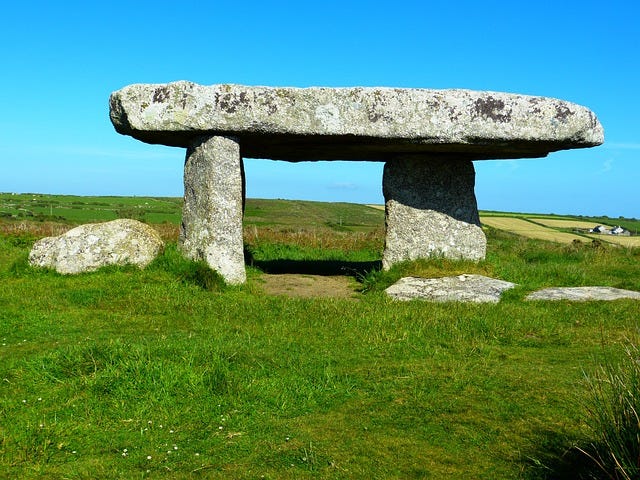
The mark is traced from Lanyon Quoit, a dolmen on the Cornish moor: a massive, thin capstone balanced across standing stones, open to the sky beneath. A dolmen is the right megalith for a parent company — it is the structure that shelters, the stones whose only purpose is to hold another stone aloft. We kept its real character: the capstone tilts, the supports are uneven, the slab cantilevers past them.
03The Lineage — Built from Trevarn's Stones
Verdegris is not styled to resemble Trevarn; it is built from it. Trevarn traces three ascending menhirs. Verdegris takes two of those same standing stones and lays a capstone across them. The parent is made of the child's stone — the clearest possible expression of the relationship between a holding company and the brand it raised.
- The standing-stone vocabulary
- The Aour Glaz palette & IBM Plex type
- The Molnár désordre principle
- The dolmen (capstone) structure
- Occluded, overlapping stones
- The parent “a verdegris company” lockup
04Désordre — The Inherited Discipline
Like Trevarn, the mark is drawn with Vera Molnár's désordre: a precise geometry perturbed by a small, deliberate percentage of disorder, so it reads as quarried by hand rather than struck by machine. Trevarn holds its stones at a light touch; Verdegris, the older and rougher of the two, sits at 2% — the same principle, weathered a degree further.
05Construction — Three Overlapping Stones
The mark is three closed stones, not a single outline. The two uprights are drawn first; the capstone is laid on top with an opaque fill, so it hides where the supports pass behind it. This occlusion is what makes it read as real, stacked stone — one resting on the others — rather than a flat, see-through diagram.